
Imagine waking up at 3:00 AM in a sub-zero mountain pass, not because you're cold, but because your factory furnace just kicked on with a roar that sounds like a jet engine. It's a common frustration for travelers who value their sleep as much as their warmth. You've likely dealt with those annoying hot and cold spots or watched your battery levels plummet because of an inefficient blower motor. It shouldn't be that way. You deserve a heating system that works as hard as you do to reach those remote destinations without sacrificing your peace of mind.
Choosing the right RV fan coil unit is the key to turning a loud, drafty cabin into a sanctuary of quiet, residential-style warmth. This guide will help you master the technical details of selecting, sizing, and installing the perfect hardware for your hydronic system. We'll walk through everything from BTU requirements to low-profile mounting techniques that save space in tight cabinets. By the end, you'll have the expert knowledge needed to ensure your mobile or marine build provides reliable, four-season comfort even when the temperature drops well below zero.
Key Takeaways
- Learn why the RV fan coil unit is the essential "lung" of your hydronic system, providing a whisper-quiet alternative to loud factory furnaces.
- Understand the science of heat transfer within a glycol loop to ensure your system extracts maximum warmth with minimal battery drain.
- Master the calculations for BTU and CFM requirements to size your air handlers perfectly for your specific van or marine cabin volume.
- Discover strategic installation tips, including floor-level mounting and ducting choices, to achieve even heat distribution without cold spots.
- See how advanced hardware like the MCS7 Controller Kit allows for precise multi-zone management and long-term reliability in off-grid environments.
What is an RV Fan Coil Unit and Why Does it Matter?
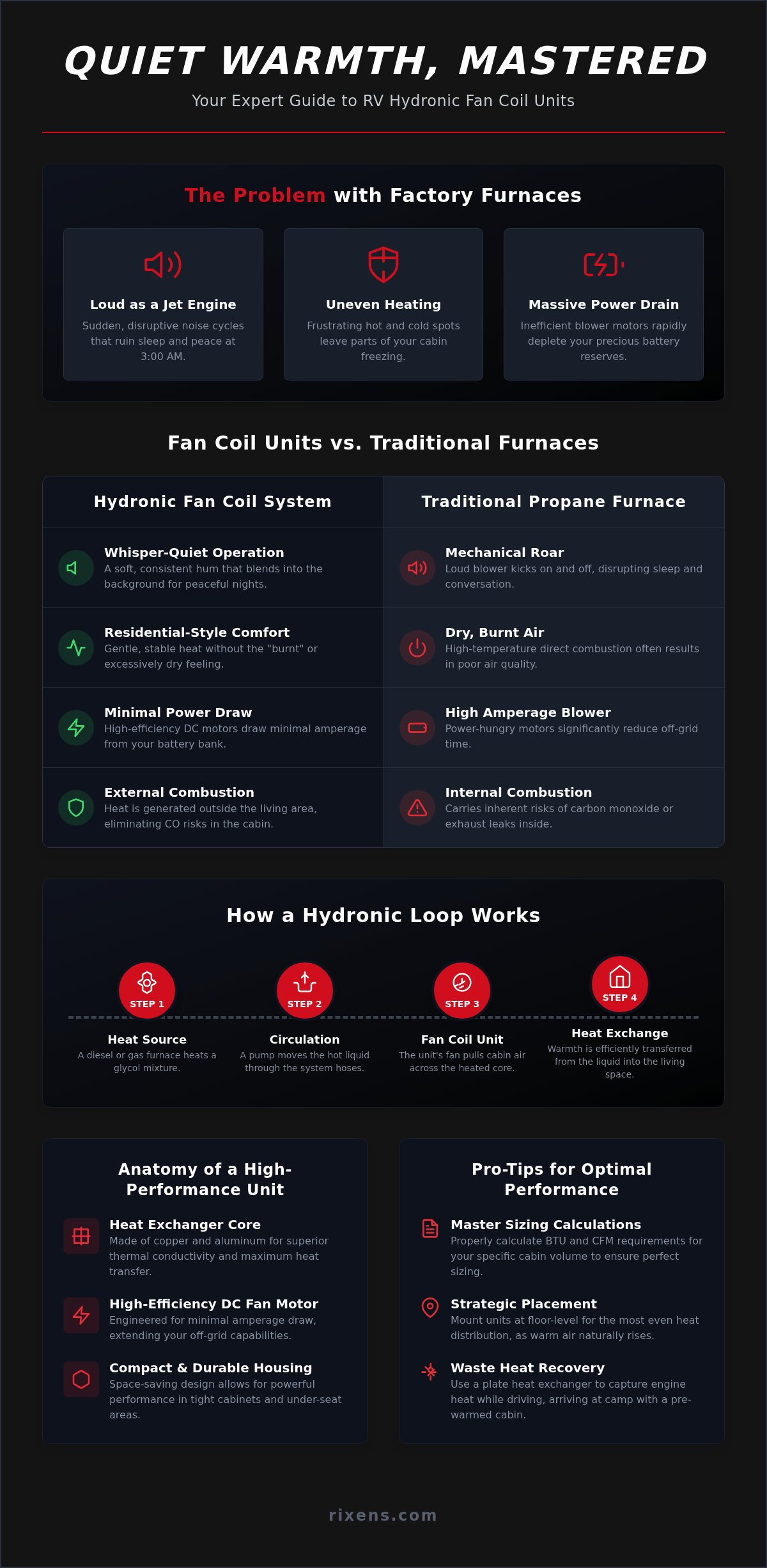
A Fan coil unit, often called an air handler, serves as the final delivery point for warmth in a hydronic heating system. Unlike a standard propane furnace that burns fuel to heat air directly, an RV fan coil unit works by circulating a heated glycol mixture through a specialized core. This liquid-to-air heat exchange provides a level of temperature stability that traditional forced-air systems simply can't match. It's why you'll find these units as the standard in luxury marine vessels and high-performance van builds where comfort is non-negotiable. In systems like our MCS One or Comfort Hot, these units act as the "lungs," distributing steady, gentle heat throughout the living space to ensure you stay warm regardless of the weather outside.
The Anatomy of a High-Performance Air Handler
The efficiency of these units depends on their internal components. We prioritize copper and aluminum for the heat exchanger core because these materials offer superior thermal conductivity. To keep your power consumption low, we use high-efficiency DC fan motors that draw minimal amperage from your battery bank. Because space is a premium in Sprinter and Transit conversions, our housing designs are compact, allowing you to tuck powerful performance into small cabinets or under-seat compartments without sacrificing storage.
Fan Coils vs. Traditional Forced-Air Furnaces
Standard RV furnaces are notoriously loud, often reaching decibel levels that disrupt sleep and conversation. Hydronic air handlers operate at a much lower frequency, creating a soft hum rather than a mechanical roar. This allows you to rest peacefully without the sudden jolt of a blower motor kicking in. Beyond acoustics, the air quality is noticeably better. Because there's no open flame or high-temperature combustion, the air doesn't feel "burnt" or excessively dry. This creates a cozy environment that feels more like a residential home than a mobile box.
Safety is another major factor for long-term travelers. Traditional furnaces require propane combustion inside the unit, which carries risks of carbon monoxide or exhaust leaks if not maintained perfectly. With a hydronic setup, the combustion happens outside the living area within the heater unit itself. The only thing entering your cabin through the RV fan coil unit is warm, safe liquid, providing you with total peace of mind during those long winter nights.
How RV Fan Coil Units Integrate into a Hydronic Loop
To understand how an RV fan coil unit functions, you have to visualize the entire hydronic circuit as a continuous loop of energy. It starts with a heat source, such as a diesel or gasoline furnace, which warms the glycol mixture. A circulation pump then moves that liquid through the system hoses. When the hot glycol reaches the fan coil, the unit's fan pulls cabin air across the heated internal fins. This process effectively "strips" the heat from the liquid and pushes it into your living space. Managing this thermal loop requires a high level of coordination, which is why we designed the MCS One Hydronic System to act as the central hub for your heating needs.
Plumbing these units can be done in two ways: series or parallel. In a series configuration, glycol flows from one unit to the next in a single line. While simpler to install, the units at the end of the line receive slightly cooler liquid because the previous units have already extracted some of the thermal energy. A parallel setup ensures each unit gets the same temperature, though it requires more complex hose routing and manifolds. We generally recommend a balanced approach that prioritizes high flow rates to keep the system performing at its peak during the coldest nights.
Waste Heat Recovery: The Secret to Efficiency
One of the most significant advantages of a well-integrated system is the ability to capture energy that would otherwise be lost. Waste heat recovery utilizes 2026 engine efficiency to provide consistent warmth without burning additional fuel while in transit. By installing a plate heat exchanger, you can safely transfer heat from your engine's cooling system to your house loop. This means your RV fan coil unit can provide a toasty interior the moment you pull into camp, all while maintaining a physical separation between your engine and heating fluids.
Plumbing Your Fan Coils for Success
Reliability in a hydronic system often comes down to the quality of the plumbing. Using the correct hose diameter is vital; if the lines are too narrow, you'll face flow restrictions that limit heat output and strain the pump. Air pockets are another common hurdle. Since air naturally rises, we place bleed valves at the highest points of the loop to ensure the glycol remains in constant contact with the heat exchanger surfaces. Any trapped air will act as a barrier to heat transfer, leaving your cabin chilly despite the heater running at full capacity.
If you're planning a complex multi-zone layout, consider using bypass valves. These allow you to isolate a specific fan coil for maintenance or to shut off heat to a specific area without interrupting the rest of the loop. Building a setup with this level of foresight reduces long-term stress and ensures your comfort remains uninterrupted. For those looking for a professional-grade starting point, our MCS One Hydronic System provides the robust architecture needed for a truly dependable build.
Sizing Your Fan Coil Units: BTU Requirements and Power Draw
Sizing is not just about choosing the most powerful heater available; it's about matching the output to the cubic footage of your cabin. An RV fan coil unit that is too small will struggle to keep up in sub-zero weather, while one that is significantly oversized might cycle too frequently, leading to annoying temperature swings. You have to consider the total volume of air and the speed at which you can circulate it, which is measured in Cubic Feet per Minute (CFM). Higher CFM ratings mean faster heat recovery after you've opened the door to step outside into the cold.
Efficiency also depends on the temperature of the glycol in your loop. Most air handlers are rated at a specific input temperature, typically around 180 degrees Fahrenheit. If your heater is running at a lower temperature to save fuel, the fan coil will produce fewer BTUs. Balancing these variables requires a methodical approach to ensure your system provides the "residential" feel that makes long-term travel sustainable.
Matching BTU Output to Vehicle Size
A standard 144" Sprinter typically requires between 6,000 and 10,000 BTUs to maintain comfort in freezing conditions. In contrast, a large Class A motorhome may require multiple units totaling over 40,000 BTUs. Your insulation, or R-value, acts as a critical multiplier here. A well-insulated van with closed-cell foam retains heat much more effectively than a factory-metal build, allowing you to use smaller, quieter air handlers. Below is a general guide for unit selection:
- 4,000 BTU Units: Ideal for small bathrooms, drying closets, or sleeping lofts.
- 8,000 - 10,000 BTU Units: The "sweet spot" for the main living area of a Class B or C van.
- 15,000+ BTU Units: Necessary for large open-concept motorhomes or poorly insulated trailers.
Managing Electrical Consumption
For off-grid travelers, every amp matters. Modern 2026 high-efficiency DC fans used in a quality RV fan coil unit typically draw between 0.5 and 2.5 amps depending on the speed setting. Simple On/Off switches are inefficient because they force the fan to run at full tilt, often overshooting the desired temperature and wasting battery capacity. This is why we prioritize variable speed control in our system designs.
We recommend using the MCS7 Controller Kit to manage these loads with precision. It uses pulse-width modulation (PWM) to vary the fan speed based on the actual heating demand. This allows the system to whisper along at a low RPM once the cabin reaches the set point, consuming a fraction of the power while maintaining a steady thermal curtain. This consultative approach to power management ensures your batteries last through the night without the stress of monitoring a monitor.
Installation and Strategic Placement for Optimal Airflow
Effective heating starts with understanding basic physics: heat rises. For an RV fan coil unit, this means floor-level mounting is non-negotiable. If you install your air handlers too high, you'll end up with a toasty ceiling and freezing feet. By placing units near the floor, you create a natural convection current that warms the entire cabin volume. You also need to decide between a direct-grill unit, which blows air straight out of the cabinet face, or a ducted model. Ducted units are excellent for larger builds where you want to distribute warmth to several different areas, such as the bedroom and the main galley, from a single hidden source.
Integrating these units into more complex systems requires careful planning. For example, if you are installing an Overland Shower or a hydronic floor heating circuit, your fan coils must be positioned to complement these heat sources rather than compete with them. Proper placement ensures that the air handler provides the quick "air heat" needed to bring the cabin to temperature while the floor loop maintains a consistent thermal mass. This layered approach creates a truly comfortable, four-season environment.
Cabinetry Integration and Stealth Mounting
Most travelers prefer to keep their hardware hidden. An RV fan coil unit can easily be tucked under a bench seat or inside a galley cabinet, but you must prioritize airflow. The most common DIY mistake is failing to provide adequate return air. If the fan cannot pull cold air from the cabin into the unit, it cannot push warm air out. We recommend a return air vent that is at least equal in size to the output grill. To keep the system whisper-quiet, use rubber vibration dampening mounts during installation. These small additions prevent the mechanical hum of the fan from resonating through your wooden cabinetry.
Plumbing Connection Best Practices
The reliability of your heating system depends on the integrity of its connections. While PEX is popular in residential builds, it can be stiff and prone to noise in a mobile environment. Specialized hydronic hose is often a better choice because it handles road vibration and thermal expansion with ease. Every connection should be secured with high-quality constant-tension clamps that won't loosen over time as temperatures fluctuate.
Before you close up your cabinets, you must perform a rigorous leak test. We suggest a 24-hour pressure test protocol. Pressurize the system and monitor the gauge for any drops; this ensures that every joint is tight and ready for years of service. If you need specialized components or advice on your specific layout, you can find everything you need in our Air Handlers & Parts collection to ensure your installation is a success.
The Rixen’s Advantage: Precision Control and Reliable Hardware
When you choose a Rixen's Enterprises, Inc. RV fan coil unit, you aren't just buying a heat exchanger; you're investing in a legacy that began in 1985. We've spent four decades refining our hardware to withstand the constant vibration of washboard roads and the extreme temperature shifts of high-altitude camping. Our air handlers are engineered for those who view their vehicle as a long-term home rather than a weekend toy. This commitment to durability means our systems are built to provide years of whisper-quiet service, backed by a team that understands the technical nuances of off-grid life. We prioritize accountability in every component we sell, ensuring you have a steady partner for your journey.
Smart Climate Management with the MCS7
The true intelligence of our system lies in the MCS7 Controller Kit. While basic thermostats simply turn a fan on or off, the MCS7 acts as a sophisticated climate manager. It monitors real-time temperature feedback to automate fan speeds, ensuring your cabin stays at a consistent set point without the loud cycling of traditional heaters. This level of precision is especially valuable for multi-zone layouts. You can keep the main living area toasty for a morning coffee while maintaining a cooler, sleep-friendly temperature in the bedroom loft. The interface is designed to be intuitive, removing the stress of managing complex technical hardware so you can focus on the destination.
Complete Hydronic Kits for DIY and Pros
Designing a custom heating loop can feel overwhelming, which is why we offer pre-engineered solutions like the MCS One Hydronic System. Buying a complete kit ensures that every RV fan coil unit, pump, and fitting is perfectly matched for flow rate and thermal efficiency. This eliminates the guesswork and potential for 404-error-style failures in the field. Whether you're a professional upfitter or a dedicated DIYer, we provide the consultative support needed to design a loop that fits your specific floor plan. Our Airtronic heater kits are specifically chosen for their high-altitude performance, ensuring your system remains reliable when you're parked at 10,000 feet.
We believe that a heating system should be a "set and forget" part of your build. By integrating our specialized hardware with expert guidance, we help you avoid the common pitfalls of uneven heat and high battery drain. If you're ready to move away from piecemeal parts and toward a unified thermal solution, exploring our Hydronic Heater Kits is the first step toward true four-season comfort. Our team remains available throughout the lifecycle of your hardware, providing the peace of mind that comes with a proven, professional-grade heating system.
Take Command of Your Off-Grid Comfort
Achieving a whisper-quiet, residential standard of warmth in your mobile build is more than just a luxury; it's the foundation of a successful long-term journey. By mastering the integration of your RV fan coil unit, you've moved beyond the limitations of noisy factory furnaces and uneven heating. You now understand how to balance BTU requirements with power consumption and why strategic floor-level placement is the secret to total cabin comfort. This methodical approach ensures that every amp and every drop of fuel is used with maximum efficiency.
Since 1985, we've helped off-grid adventurers navigate these technical decisions with hardware that's built to last. Whether you're utilizing our industry-leading MCS7 digital control technology or seeking specialized technical support for a custom installation, we're here to ensure your system performs flawlessly in sub-zero temperatures. We take pride in being more than a supplier; we're your partner in creating a reliable, four-season home on the road.
Explore Rixen’s High-Performance Air Handlers & Parts today and start designing a heating system that provides true peace of mind. Your next great adventure deserves the stability and comfort of a master-crafted hydronic solution.
Frequently Asked Questions
What is the difference between an air handler and a fan coil unit?
There is no functional difference between an air handler and a fan coil unit in the RV industry. Both terms refer to the hardware that pulls heat from a liquid loop and blows it into your living space. We often use the terms interchangeably when discussing our Air Handlers & Parts. The goal is always the same: providing efficient, quiet heat transfer for your mobile or marine environment through a master-crafted thermal loop.
How many fan coil units do I need for a 170" wheelbase Sprinter van?
For a 170" wheelbase Sprinter, we generally recommend installing two units to maintain consistent comfort. Placing one RV fan coil unit in the front galley and a second in the rear sleeping area eliminates cold spots. This dual-zone approach, managed by an MCS7 controller, ensures that your entire cabin stays warm without overworking a single unit. It provides the redundancy and even distribution needed for sub-zero travel.
Can I use my engine heat to run the fan coil units while driving?
You can definitely utilize engine heat to power your fan coils while you are in transit. By integrating a plate heat exchanger into your MCS One system, you capture thermal energy that would otherwise be wasted. This allows you to arrive at your campsite with a pre-warmed interior and hot water, all without burning a single drop of extra fuel. It's a highly efficient way to manage your energy on the road.
Are RV fan coil units noisy compared to standard furnaces?
Hydronic units are far quieter than traditional forced-air propane furnaces. While a standard furnace often disrupts sleep with a loud mechanical roar, our air handlers use high-quality DC motors. These fans produce a gentle, steady hum that feels more like a residential HVAC system. It's a significant upgrade for travelers who value a peaceful night's rest and a calm cabin environment during the day.
Do hydronic fan coils require a lot of maintenance?
These units are remarkably low-maintenance because they have very few moving parts. Your main responsibility is ensuring the intake and output grills remain free of dust and pet hair to maintain airflow. Beyond that, you should periodically check your glycol levels and hose connections for any signs of wear. This simple routine ensures your system remains reliable and safe for years of off-grid use without the need for complex repairs.
Can I run a fan coil unit off a 12V battery system?
Every RV fan coil unit we sell is designed specifically for 12V DC battery systems. These high-efficiency fans draw minimal power, often between 0.5 and 2.5 amps depending on the speed setting. This low draw is critical for off-grid builds where battery capacity is a precious resource. It allows you to stay warm through the night without the stress of draining your power bank or requiring a shore power connection.
What happens if air gets trapped in my fan coil unit?
Trapped air creates a blockage that prevents hot glycol from circulating through the internal heat exchanger. If you notice a unit is blowing cold air despite the heater being on, an air pocket is likely the culprit. You can resolve this by using a bleed valve at the high point of the loop. Ensuring the system is fully primed with liquid is essential for optimal thermal performance and long-term pump health.
Can I use a fan coil unit for cooling as well as heating?
Standard hydronic fan coils are engineered for heating rather than cooling. While the fan can circulate ambient air to provide a breeze, the unit cannot provide air conditioning. True cooling requires a refrigerated loop and a way to manage condensation, which isn't a feature of a standard heating-focused air handler. For cooling, you would typically need a dedicated AC system or a specialized heat pump designed for that specific purpose.
