
You're deep in the wilderness, the stars are bright, and you've finally settled into a deep sleep, only to be jolted awake by the jet-engine roar of your propane furnace kicking on. We've all been there, staring at the ceiling while a loud blower motor cycles endlessly, draining your batteries and leaving the floor freezing. It's a frustrating trade-off many travelers accept as the price of staying warm, but it doesn't have to be your reality. If you're tired of the noise, exploring quiet RV furnace alternatives is the first step toward a truly peaceful off-grid experience.
I've spent decades helping owners move away from these disruptive systems toward solutions that offer lasting reliability and peace of mind. True comfort requires shifting from turbulent, dry forced air to the consistent, radiant-style warmth of hydronic fluid systems. In this guide, we'll explore how advanced technologies like the MCS One hydronic system and Airtronic heater kits provide a near-silent sleeping environment. You'll learn how to achieve efficient fuel consumption and reliable heat that protects your plumbing even in sub-zero temperatures, ensuring your focus remains on the journey rather than the hardware.
Key Takeaways
- Identify the mechanical causes of furnace noise, from high-speed blower motors to duct turbulence, and why they disrupt your rest.
- Compare the most effective quiet RV furnace alternatives to find a solution that balances silent operation with high-altitude reliability.
- Learn why hydronic heating is the gold standard for off-grid travelers, using glycol and low-RPM air handlers to provide whisper-quiet warmth.
- Discover how specialized mounting techniques and intake silencers can further isolate vibration and reduce exterior exhaust noise.
- Understand how integrated systems like the MCS One provide consistent heat and hot water while protecting your plumbing in sub-zero temperatures.
Why Standard RV Furnaces Are So Loud: The Forced Air Problem
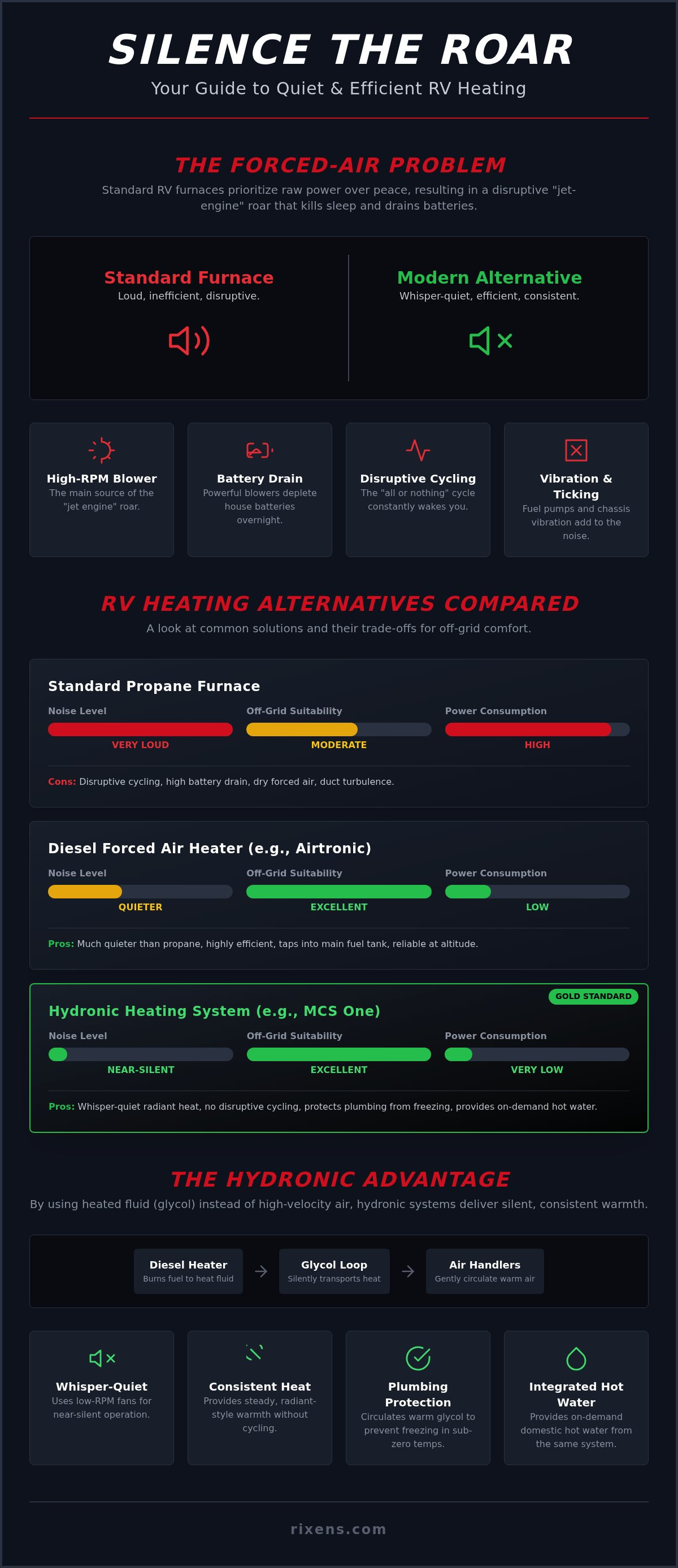
Most standard RV furnaces are designed for cost-efficiency and rapid heating rather than acoustic comfort. They rely on high-RPM blower motors that must move a massive volume of air across a metal heat exchanger in a very short time. This mechanical urgency creates a "jet engine" roar that is often the loudest sound in an RV. When you're looking for quiet RV furnace alternatives, you're really looking for a way to move heat without that high-velocity turbulence.
The disruption isn't just about the decibel level; it's about the frequency. Standard furnaces operate on a binary "all or nothing" cycle. They blast hot air until a thermostat is satisfied, then shut off completely. This constant cycling creates a pattern of loud noise followed by sudden silence, which is far more likely to wake you up than a steady, low-level hum. Additionally, these high-powered blowers are notorious battery killers, often pulling significant amperage that can leave your house batteries depleted by morning.
The Physics of Air Movement vs. Noise
Noise in a forced-air system is largely a result of friction. In the cramped confines of an RV, ductwork is often narrow and contains sharp bends. As air is forced through these restrictions at high speeds, it creates turbulent "white noise" that resonates through the entire cabin. Because RV walls are typically thin and lack the dense acoustic insulation found in residential homes, they act like a sounding board, amplifying every vibration from the furnace cabinet directly into your living space. This is why even a "quiet" propane furnace can still feel overwhelming in a small interior.
Secondary Noise Sources: Fuel Pumps and Igniters
The blower motor is the primary culprit, but it's rarely the only one. Many owners are kept awake by the rhythmic ticking of a fuel pump or the sharp "snap" of an electronic igniter. These sounds are often conducted through the vehicle's chassis, making them seem much closer than they actually are. Other common noise factors include:
- Combustion fans: These high-pitched motors pull in fresh air for the burner and can create a piercing whine that cuts through the night.
- Ignition sequences: The "clunk" of a gas valve and the subsequent "whoosh" of combustion can sound like a small explosion in a quiet interior.
- Vibration: If the furnace isn't perfectly isolated, the entire floor can vibrate, turning the bed frame into a speaker that transmits mechanical hums directly to the sleeper.
Understanding these mechanical limitations is the first step in designing a better system. By moving away from high-velocity air and focusing on more stable heating methods, you can finally achieve the silence that off-grid living is supposed to provide.
Comparing Quiet RV Heating Alternatives
Finding the right balance between silence and off-grid performance requires a look beyond simple electric space heaters. While many travelers start their search for quiet RV furnace alternatives by looking at portable units, the reality of power consumption and safety often leads them back to permanent, professional installations. Each alternative comes with specific trade-offs that affect your comfort and your battery bank's health.
Portable electric heaters are perfectly silent, but they're restricted to shore power or massive, expensive battery banks. A typical 1500W heater will deplete a standard battery setup in hours. Catalytic and radiant heaters offer silent operation without electrical power, but they're unvented. This means they consume your interior oxygen and release significant moisture, leading to condensation and mold issues. Diesel forced air heaters, such as our Airtronic Heater Kits, provide a powerful middle ground. They're much quieter than standard propane furnaces, though they still benefit from specialized silencing kits to reach peak performance.
Hydronic heating stands as the premium choice for those seeking total silence. By using a liquid medium to transport heat, these systems eliminate the need for the high-velocity blowers found in standard furnaces. The result is a steady, radiant-style warmth that doesn't roar or cycle disruptively.
Off-Grid Capability vs. Sound Levels
When ranking heaters by decibel (dB) levels, hydronic systems and electric heaters lead the pack for silence. However, for 24/7 off-grid use, diesel and propane remain the only viable fuel sources due to their energy density. Diesel is particularly efficient for long-term stays. It taps directly into the vehicle's fuel tank, which eliminates the need to hunt for propane refills in remote areas. A well-designed diesel or hydronic system can run safely for days on end while maintaining a near-silent interior environment.
Safety and Air Quality Considerations
Safety is where the master craftsman's approach to heating truly matters. Unvented heaters pose a risk of carbon monoxide buildup and oxygen depletion in small, airtight RVs. Professional systems utilize external combustion, where all exhaust and intake happen outside the living space. This keeps the air inside dry and healthy. High-quality systems like the MCS One take this further by using a closed loop of glycol to move heat. This ensures no combustion gases ever enter the cabin, providing peace of mind alongside consistent warmth.
The Hydronic Advantage: Why Fluid Heat is the Gold Standard
Hydronic heating represents a fundamental shift in how we approach climate control. Instead of fighting the physics of air turbulence, these systems use a closed loop of glycol to move thermal energy silently throughout the vehicle. This is why they're widely considered the most effective quiet RV furnace alternatives for travelers who value undisturbed rest. When you move heat via liquid rather than high-velocity air, you eliminate the primary source of noise found in traditional systems.
The secret to this silence lies in the air handlers. Unlike a central furnace blower that must force air through long, restrictive ducts, hydronic systems use multiple small heat exchangers placed exactly where warmth is needed. These units utilize low-RPM fans that provide whisper-quiet operation. Because these fans don't need to overcome massive static pressure, they can run at a fraction of the noise level of a standard furnace while still providing effective warmth.
Another key benefit is steady-state operation. A standard furnace blasts heat until the thermostat is satisfied, leading to the disruptive on-off cycle that often wakes light sleepers. A hydronic system can modulate its output, staying on longer at a lower, nearly imperceptible volume. This creates a consistent thermal mass that eliminates the hot and cold spots common in forced-air layouts, ensuring the floor and corners of your RV stay as warm as the ceiling.
Silent Water Heating and Cabin Warmth
Standard RV designs often separate air and water heating, which is often inefficient and noisy. The MCS One Hydronic System solves this by acting as a single, silent unit for both needs. By using high-efficiency heat exchangers, it provides endless hot water without the need for a noisy, rattling tank. This integrated approach also allows for silent heating of the RV basement and plumbing bays. It protects your pipes in sub-zero temperatures without the roar of a traditional furnace, giving you peace of mind during winter expeditions.
Precision Control with the MCS7
A high-performance heating system is only as good as its brain. The MCS7 Controller Kit provides the precise management necessary to prevent temperature hunting. It allows you to customize fan speeds, including a dedicated silent mode for nighttime use. For those looking for maximum efficiency, the system can even integrate engine waste heat. This provides free silent warmth for the cabin and hot water while you're driving; your space is comfortable the moment you pull into camp without ever burning a drop of extra fuel.
Planning Your Retrofit: Installation for Maximum Silence
Selecting the right hardware is only the first step in your journey toward a peaceful interior. Even the most advanced quiet RV furnace alternatives can underperform if the installation doesn't account for mechanical resonance and air velocity. To achieve true silence, you must treat the installation as a holistic system where every mounting point and connection is an opportunity to dampen sound.
Positioning is your primary tool for noise reduction. We recommend mounting the main heating unit in a location that is structurally isolated from the main sleeping area, such as an exterior-access compartment. This physical distance provides a natural buffer. However, the exterior environment matters too. High-quality intake and exhaust silencers are essential components that prevent your heater from sounding like a jet engine to your neighbors. These silencers work by breaking up the pressure waves of the combustion process, ensuring your presence at a trailhead remains discreet.
Ducting also plays a massive role in the acoustic profile of your cabin. To reduce air velocity noise, we use larger diameter ducting and minimize sharp 90-degree bends. Every curve in a duct creates friction and turbulence, which translates to that annoying "whooshing" sound. By prioritizing smooth, straight runs, you allow the air to move at a lower pressure, which significantly drops the decibel level inside your living space.
Vibration Isolation and Sound Dampening
Vibration is often the hidden culprit behind a noisy cabin. When a heater or fuel pump is bolted directly to the vehicle chassis, the metal frame acts like a sounding board, amplifying every mechanical pulse. That infamous "ticking" fuel pump noise is almost always an installation failure rather than a hardware defect. By using specialized rubber iso-mounts, you can decouple these components from the frame. For the heater compartment itself, applying automotive-grade sound-deadening mats to the surrounding walls can further absorb high-frequency whines before they enter the cabin.
Professional vs. DIY Installation
While many enthusiasts enjoy the challenge of a DIY project, hydronic systems involve complex plumbing and electrical integration that often benefit from a master craftsman's touch. An expert can ensure that the coolant loop is perfectly bled and that the system is tuned for high-altitude performance without increasing combustion noise. If you're ready to move away from noisy, inefficient heating, you can explore our hydronic heater kits to find a professional-grade solution tailored to your specific vehicle layout. Getting the installation right the first time ensures your investment provides the long-term reliability and peace of mind you deserve.
Rixen’s Solutions: Airtronic and MCS Hybrid Systems
Choosing the right hardware is the final step in securing a peaceful off-grid environment. While we've discussed the theory of noise reduction, the practical implementation relies on high-performance components. Airtronic Heater Kits have become the preferred choice for van-life enthusiasts who demand silence without sacrificing space. These kits offer a significant upgrade over generic diesel heaters because they utilize precision-engineered components that minimize vibration and combustion noise. When you're looking for quiet RV furnace alternatives, these systems provide a level of refinement that standard propane units simply can't match.
For travelers who want a comprehensive solution, the MCS One stands as the "Swiss Army Knife" of silent RV heating. It integrates cabin warmth and domestic hot water into a single, compact footprint. This system allows for extensive customization, ranging from hydronic floor heat that keeps your feet warm on winter mornings to our Overland Shower systems for off-grid hygiene. By centralizing these functions, you reduce the number of mechanical components that can fail or create noise, leading to a more reliable and serene living space.
Advanced Airtronic Integration
The true power of our systems lies in how they integrate. We often pair Airtronic kits with hydronic loops to create a hybrid setup that offers ultimate versatility. The brain behind this operation is the MCS7 Controller Kit. It's the secret to silent operation because it manages fan speeds and heat output with digital precision, preventing the loud, sudden cycles that wake you up at night. For larger RV interiors, we utilize high-performance air handlers that move air effectively at lower RPMs, maintaining silence even when the temperature outside drops well below freezing.
Expert Support and System Longevity
Investing in a Rixen’s system means entering into a long-term partnership. We believe that professional consultation is vital for custom builds, ensuring that your heating layout is optimized for your specific vehicle and travel style. Our commitment to durability is rooted in our history; we've been dedicated to providing high-performance, reliable heating solutions since 1985. This longevity means you’ll have access to parts and expert support for the life of your vehicle. We focus on enduring quality because we know that when you're miles from the nearest town, peace of mind is the most valuable luxury you can have.
Achieve Lasting Peace on the Open Road
Transitioning to a silent interior is about more than just lowering the decibels; it's about reclaiming the quality of your sleep and the comfort of your living space. We've explored how moving away from high-velocity forced air toward the steady warmth of hydronic systems eliminates the jet engine roar and the heavy battery drain of standard units. By focusing on precision installation and advanced digital management, you can finally enjoy a cabin that stays warm without the constant, disruptive cycling of traditional heaters. When evaluating quiet RV furnace alternatives, the goal should always be long-term reliability and a system tailored to your specific travel needs.
With over 40 years of mobile heating expertise, our team is here to help you navigate these technical decisions with confidence. From our proprietary MCS One hydronic technology to the industry-leading MCS7 digital controllers, we provide the hardware and guidance needed for a near-silent off-grid experience. You deserve a heating solution that works as hard as you do to make every journey memorable. Build your silent heating system with Rixen’s Expert Guidance and find the perfect balance of warmth and silence for your next adventure.
Frequently Asked Questions
Are diesel heaters quieter than propane RV furnaces?
Diesel heaters are significantly quieter because they don't require the massive air volume of a traditional propane furnace. A standard furnace uses a large blower to push air through long ducts, while a diesel unit like our Airtronic Heater Kits uses a more compact, efficient fan. When paired with proper intake and exhaust silencers, a diesel system operates at a much lower decibel level, making it one of the most popular quiet RV furnace alternatives for light sleepers.
Can I replace my existing propane furnace with a hydronic system?
You can certainly replace a propane furnace with a hydronic system, though it requires a different approach to installation. Instead of large air ducts, you'll install a network of flexible PEX tubing to carry heated glycol to small air handlers. This retrofit allows you to reclaim cabinet space and achieve a level of silent, consistent warmth that traditional forced-air units simply cannot provide. It's a professional-grade upgrade that transforms your interior comfort.
How do I stop the 'ticking' noise from my RV heater fuel pump?
Stopping the ticking noise requires decoupling the fuel pump from your vehicle's chassis. That sound is caused by mechanical pulses traveling through the metal frame of your RV. By using specialized rubber iso-mounts and ensuring the pump is angled correctly, you can effectively isolate these vibrations. This simple adjustment often transforms a disruptive installation into a near-silent system that won't wake you up at night, providing the peace of mind you expect from a high-quality build.
Is hydronic heating worth the investment for a camper van?
Hydronic heating is exceptionally well-suited for camper vans due to its integrated, space-saving design. A single unit like the MCS One provides both cabin heat and domestic hot water, eliminating the need for a separate, bulky water heater. While the initial setup is more involved, the long-term reliability and the ability to enjoy a silent, moisture-free interior make it the gold standard for full-time van life. It's an investment in both your vehicle's value and your daily comfort.
Can a quiet RV furnace alternative also provide hot water?
Yes, advanced hydronic systems are designed to provide both air heating and endless domestic hot water. By using a plate heat exchanger, the system transfers heat from the glycol loop to your fresh water on demand. This integrated approach is more efficient than running two separate appliances and ensures you have a reliable hot shower available whenever the heating system is active. It simplifies your utilities while maintaining a near-silent environment throughout the vehicle.
Do quiet heating systems use more battery power?
Quiet heating systems typically use significantly less battery power than standard propane furnaces. A traditional furnace blower motor is one of the largest DC loads in an RV, often pulling between 7 and 10 amps. In contrast, the low-RPM fans in hydronic air handlers pull a fraction of that power. This efficiency allows you to stay off-grid longer without worrying about depleting your house batteries overnight, even during the coldest winter expeditions.
What is the best heater for high-altitude RV camping?
The best heaters for high-altitude camping are those with automatic altitude compensation, such as our Airtronic and MCS One systems. At high elevations, thinner air can cause standard heaters to soot up and become noisy or fail. Our systems adjust the fuel-to-air ratio electronically, ensuring clean, quiet combustion and reliable performance even when you're camped at 10,000 feet or higher. This specialized technology prevents the maintenance headaches common with less advanced alternatives.
How loud is a hydronic air handler compared to a standard blower?
A hydronic air handler is whisper-quiet compared to the roar of a standard furnace blower. While a traditional furnace can reach decibel levels that make conversation difficult, a low-RPM hydronic fan is barely audible from a few feet away. This difference is due to the smaller fan blades and the lack of high-pressure ducting, which allows air to move gently into the living space. It's the most effective way to maintain a steady temperature without the mechanical noise.
