
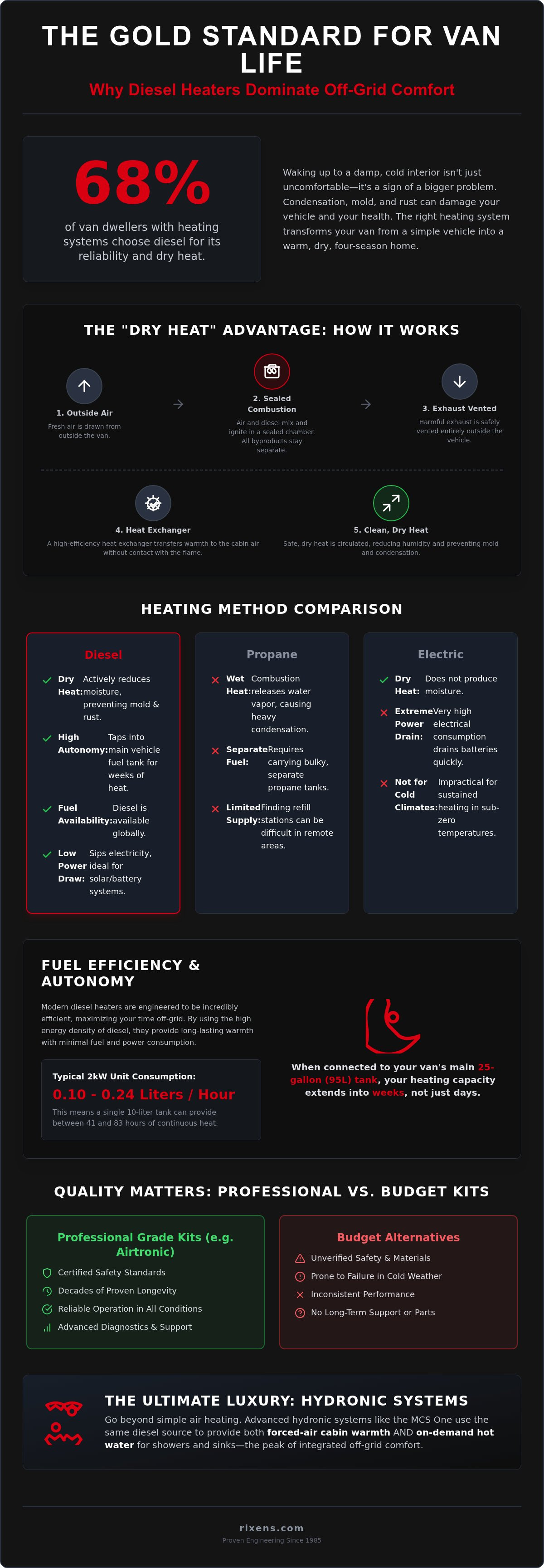
Recent data shows that 68% of van dwellers who invest in a heating system choose diesel as their primary source. If you've ever woken up to a damp, biting chill or spent your morning wiping condensation off the windows, you know that staying warm is about more than just the temperature. It's about maintaining a dry, healthy environment. Many travelers feel the stress of managing multiple fuel sources like propane or worry about the long-term reliability of budget units. You deserve a heating solution that works every time you flip the switch, allowing you to focus on the journey ahead.
In this guide, we'll explore why the benefits of diesel heater in van builds make it the gold standard for 2026. You'll discover how these systems provide efficient, four-season warmth while integrating seamlessly with your vehicle's existing fuel tank. We'll look at the technical advantages of professional-grade hardware, such as Airtronic kits or the MCS One hydronic system for combined air and water heating. From precision climate control with the MCS7 to the peace of mind that comes from 40 years of specialized engineering, this article provides the clarity you need for a truly comfortable off-grid home.
Key Takeaways
- Learn why tapping into your vehicle's main fuel tank provides superior energy density and autonomy compared to propane or electric setups.
- Understand the technical reasons why the benefits of diesel heater in van systems include a "dry heat" that actively prevents mold and rust.
- Explore how hydronic systems like the MCS One provide the ultimate luxury of integrated cabin warmth and on-demand hot water.
- See how modern heaters maintain low electrical draw, making them perfectly compatible with off-grid solar and battery configurations.
- Identify the critical safety and longevity differences between professional-grade Airtronic kits and budget alternatives to ensure long-term reliability.
Why Diesel Heaters are the Gold Standard for Van Life
Diesel heaters have earned their reputation as the premier choice for off-grid travel because they solve the most fundamental challenge of van life: consistent, dry warmth. Unlike portable solutions, a diesel heater is a sophisticated, vehicle-integrated system that draws fuel directly from your van’s main tank. This setup functions much like an Auxiliary Power Unit (APU) found in aircraft or large trucks, providing essential climate control without needing the main engine to run. By utilizing the high energy density of diesel fuel, these systems offer a level of autonomy that other fuel sources simply can't match.
The primary benefits of diesel heater in van builds center on reliability and simplicity. Since 1985, we've seen these systems evolve from rugged commercial trucking components—often optimized by industry leaders like Diesel Freak—into the refined, whisper-quiet Airtronic Heater Kits used in modern luxury builds. This heritage of long-term durability means you aren't just buying a heater; you're investing in a proven engineering standard that has supported professional drivers for decades. It's a professional-grade alternative to budget DIY heaters that often fail when you need them most.
How Diesel Combustion Heaters Work
The magic of these units lies in the sealed combustion process. Outside air is pulled into a burner, mixed with fuel, and ignited within a sealed chamber. The resulting exhaust gases are then routed entirely outside the vehicle through a dedicated exhaust pipe. This process ensures that no carbon monoxide or combustion byproducts ever enter your living space.
A precision metering pump delivers the exact amount of fuel needed for the desired temperature, while a high-efficiency heat exchanger transfers that warmth to your cabin air or liquid coolant. Because the interior air never comes into contact with the flame, the heat is clean and safe. This sophisticated management of intake and exhaust air allows the system to operate efficiently even in high-altitude environments where oxygen levels are lower.
Diesel vs. Propane vs. Electric Heating
Choosing between heating methods often comes down to efficiency and moisture management. Propane heaters are a common alternative, but they present a significant moisture problem. Burning propane releases water vapor into the air; in a small van, this leads to heavy condensation, mold, and eventual rust. Diesel heaters provide a "dry" heat that actively reduces humidity, protecting your insulation and your health.
Electric heating is another option, but even the best lithium batteries struggle with the heavy loads required to fight sub-zero temperatures for extended periods. One of the most compelling benefits of diesel heater in van design is the "one fuel source" philosophy. By tapping into the diesel already in your tank, you eliminate the need to carry separate propane canisters or manage complex electrical arrays just for heat. It streamlines your build and ensures that as long as you have fuel to drive, you have the means to stay warm.
Maximizing Off-Grid Autonomy with Fuel Efficiency
One of the most significant benefits of diesel heater in van life is the massive boost to your off-grid autonomy. Instead of carrying separate fuel canisters, you rely on your vehicle's primary reservoir. This integration removes the range anxiety associated with propane, where running out of heat means finding a specialized filling station. With a diesel system, as long as you have enough fuel to reach a gas station, you have days of continuous warmth. Advanced management tools like the MCS7 Controller Kit further optimize this by allowing you to set precise schedules and temperatures, ensuring you never waste energy when you're away from the vehicle.
Modern diesel systems are designed to be extremely efficient, sipping fuel rather than gulping it. This allows for extended stays in remote locations without the need to return to civilization for supplies. Whether you're parked at a trailhead for a week or traversing a remote mountain pass, the consistency of diesel fuel ensures your living space remains a sanctuary.
Calculating Your Fuel and Power Needs
Efficiency is measurable and predictable. For a standard 2kW unit, which is sufficient for most medium-sized vans like a Sprinter or Transit, fuel consumption typically ranges from 0.10 to 0.24 liters per hour. In practical terms, a 10-liter tank can provide between 41 and 83 hours of heat depending on the power setting. When you tap into a 25-gallon vehicle tank, your heating capacity extends into weeks rather than days.
Electrical requirements are equally manageable for modest solar and battery setups. The initial startup requires a brief surge of roughly 8 to 10 amps to heat the glow plug, but this lasts only a few minutes. Steady-state draw is the low-power phase after initial ignition, often consuming only 1 to 2 amps per hour. This low demand means you won't wake up to a dead house battery, even during the darkest winter months.
The Convenience of a Single Fuel Source
Transitioning to a single fuel source simplifies your build and improves your daily workflow. Propane requires heavy steel lockers, external venting, and frequent stops at hardware stores. Diesel is available at every gas station worldwide, making it the only logical choice for international overlanding or long-term travel. You'll never have to worry about finding a specific fitting or a technician to certify a pressurized tank in a foreign country.
Removing propane infrastructure also provides significant weight savings. By eliminating heavy tanks and mounting hardware, you increase your available payload for water, gear, or interior finishes. We find that our clients value the peace of mind that comes from 40 years of engineering expertise found in our Airtronic Heater Kits, which integrate seamlessly into the vehicle's existing infrastructure without the clutter of secondary fuel systems.
The "Dry Heat" Advantage: Preventing Mold and Condensation
Moisture is the silent enemy of any van build. While staying warm is a priority, the method you choose to heat your space determines whether your interior stays preserved or slowly degrades. One of the most critical benefits of diesel heater in van applications is the production of "dry heat." Unlike unvented propane heaters that release quarts of water vapor into the cabin as a byproduct of combustion, diesel systems exhaust all moisture and combustion gases outside. This fundamental difference in chemistry prevents the damp, heavy air that often plagues smaller mobile living spaces.
By circulating warm, dry air, our Airtronic Heater Kits act almost like a dehumidifier for your living quarters. This constant movement of air prevents stagnant pockets of humidity from settling in corners or behind cabinetry. Protecting your investment means keeping your woodwork, electronics, and insulation dry. When you choose a professional-grade diesel system, you're choosing to extend the life of every component in your van build.
Understanding Condensation in Van Life
Waking up to ice on the inside of your windows is a classic van life struggle that usually stems from poor heating choices. When you use an unvented heat source, the humidity levels spike, and that moisture immediately seeks out the coldest surfaces. The dew point represents the specific temperature at which air becomes saturated and begins to deposit liquid water onto cold surfaces like metal pillars or window glass. Once this moisture reaches the metal skin of your van, it can lead to hidden rust and ruined insulation.
A diesel heater works in harmony with your ventilation system, such as a MaxxAir fan, to create a pressurized environment of fresh, warm air. This airflow pushes moist air out through the vents rather than letting it settle. It's a proactive approach to climate management that ensures your mornings are spent enjoying the view rather than wiping down soaking wet walls.
Health and Structural Benefits
Maintaining a dry environment is a matter of health as much as comfort. High humidity in a small space quickly leads to mold and mildew growth, which can cause persistent respiratory issues for travelers. By keeping the "void" spaces behind your walls dry, you prevent the growth of these allergens in areas you can't easily clean. It provides a level of peace of mind that a simple space heater cannot offer.
There is also a significant psychological benefit to dry heat. Anyone who has spent a winter in a van knows the misery of damp bedding and "clammy" clothes. Diesel heating ensures that your fabrics and mattress stay crisp and dry, regardless of how much it's raining or snowing outside. This level of comfort is why we focus on high-quality, reliable hardware that handles the tough work of moisture control for you.
Hydronic Diesel Heating: The Ultimate Luxury Integration
While forced-air units are excellent for many travelers, premium builds often require a more sophisticated approach to climate control. Hydronic systems represent the pinnacle of mobile comfort. Instead of just blowing hot air, these systems circulate heated glycol through a closed loop of plumbing. This liquid-based method allows for silent, consistent warmth that mimics the comfort of a high-end home. One of the most advanced benefits of diesel heater in van design is the ability to install radiant floor heating. Stepping onto a warm floor on a sub-zero morning transforms the van life experience from "camping" to true luxury living.
Hydronic setups also unlock the ability to capture engine waste heat. As you drive, the heat generated by your vehicle's engine can be transferred to your living space and water tank through a heat exchanger. This provides "free" heat and hot water the moment you park at your campsite. It's an efficient use of energy that air-only heaters simply can't provide. It ensures your sanctuary is already warm before you even turn the heater on.
Integrated Hot Water Solutions
A major advantage of the MCS One Hydronic System is how it consolidates your utilities. In a standard build, you might need a bulky electric water heater and a separate air heater. A hydronic system combines these functions into one compact footprint. This integration provides continuous hot water for systems like the Overland Shower, allowing for comfortable showers without the long wait times of traditional tanks. By merging two massive utilities, you reclaim valuable cabinet space for gear and storage.
Precision Control with the MCS7
Managing a complex hydronic system requires more than a simple high-low dial. The MCS7 Controller Kit provides a professional digital interface that allows for precision climate management. You can move beyond basic settings to achieve exact thermostat-controlled comfort. This level of control enables multi-zone heating, where you might keep your gear garage cool to save energy while maintaining a cozy temperature in the sleeping area. It’s about having the right temperature in the right place at the right time.
The benefits of diesel heater in van builds are most apparent when you don't have to think about the hardware. A well-designed hydronic loop, supported by our 40 years of engineering expertise, offers a set-and-forget reliability that budget units lack. It creates a seamless environment where heat and water are always ready. This professional-grade approach reduces the stress of technical decisions, letting you enjoy the peace of mind that comes from a truly integrated system.
Ensuring Long-Term Reliability: Quality Kits vs. Budget Units
Choosing a heating system for your van often involves a choice between short-term savings and long-term security. While the market is flooded with low-cost heaters, the true value of your investment is measured by its performance when the temperature drops in a remote location. A heater failure in the middle of a winter expedition isn't just an inconvenience; it's a safety risk that can end a trip prematurely. Premium systems like Eberspächer Airtronic Heater Kits are engineered to meet rigorous safety standards that budget units simply cannot match. This engineering ensures that every component, from the fuel pump to the internal sensors, is designed for the high-vibration environment of a moving vehicle.
One of the most significant benefits of diesel heater in van travel is the confidence to explore without limits. This confidence comes from hardware that has been tested in extreme conditions for decades. We focus on providing professional-grade alternatives to "budget" DIY heaters because we believe in accountability and enduring partnerships. When you're miles from the nearest paved road, the reliability of your climate control system becomes the foundation of your peace of mind.
High-Altitude Challenges and Solutions
Mountain travelers face a specific technical hurdle: the "soot problem." Standard heaters often begin to "coke up" when operating above 5,000 feet because the thin air causes an over-rich fuel mixture. This leads to carbon buildup that eventually chokes the burner and causes the unit to fail. Premium Airtronic Heater Kits solve this with automatic altitude compensation, which adjusts the fuel flow to match oxygen levels in real-time. The MCS7 Controller Kit manages these high-altitude cycles by optimizing fuel-to-air ratios to prevent carbon buildup in thin air, ensuring the burner stays clean whether you're at sea level or crossing a high mountain pass.
The Rixen’s Difference: 40 Years of Support
Since our founding in 1985, we've learned that a reliable system is more than just a box of parts. It requires a comprehensive approach to installation and ongoing care. Our specialized kits go beyond the heater itself, including custom wiring harnesses and specialized mounting brackets that simplify the technical decisions for your build. This methodical approach ensures that every detail has been considered before the first hole is drilled in your van's floor.
We view our relationship with you as a long-term partnership rather than a simple transaction. By choosing a professional kit, you gain access to a team that stands behind the hardware for the entire lifecycle of your vehicle. This level of specialized knowledge and personalized attention is one of the most enduring benefits of diesel heater in van builds, providing a steady, dependable guide for your off-grid journey.
Invest in Your Long-Term Off-Grid Comfort
Transitioning to a diesel system provides a single, efficient fuel source and eliminates the humidity issues associated with propane. We've explored how professional-grade hardware like the MCS One integrates cabin heat and hot water into one compact footprint. These systems aren't just heaters; they're the foundation of a dry, healthy living space that protects your vehicle for years to come. Realizing the full benefits of diesel heater in van builds requires moving beyond budget parts to engineered solutions that work every time.
With over 40 years of specialized heating expertise, we've designed our proprietary MCS One and MCS7 technology to withstand the harshest off-grid and marine environments. You don't have to navigate these complex technical decisions alone. Our team is here to ensure your build succeeds through personalized attention and proven reliability. Explore Rixen’s Specialized Hydronic and Airtronic Heater Kits today and take the first step toward a warmer, more reliable adventure. Your journey deserves the peace of mind that only expert engineering can provide.
Frequently Asked Questions
Are diesel heaters safe to run while sleeping in a van?
Yes, diesel heaters are safe to run while sleeping because they use a sealed combustion chamber. This design ensures that the air you breathe inside never touches the flame or exhaust gases. For absolute peace of mind, we always recommend installing a carbon monoxide detector. High-quality systems like our Airtronic Heater Kits are built to rigorous safety standards to ensure your environment remains warm and secure throughout the night.
How much diesel does a van heater use per night?
A standard 2kW heater typically consumes between 0.10 and 0.24 liters of fuel per hour. If you run the heater for eight hours overnight, you'll use roughly 0.8 to 1.9 liters of fuel. This efficiency is one of the primary benefits of diesel heater in van builds, as a small tank provides days of warmth. It allows you to stay off-grid longer without worrying about your fuel levels.
Can I install a diesel heater if my van runs on gasoline?
You can definitely use a diesel heater in a gasoline van by installing a separate auxiliary fuel tank. These small tanks, often holding 10 liters, are easy to mount and fill independently. This configuration allows gasoline van owners to enjoy the superior efficiency and dry heat of diesel without modifying their vehicle's primary fuel system. It's a common solution for travelers who want the best heating performance available.
Do diesel heaters require a lot of maintenance?
These systems are designed for set and forget reliability and require minimal maintenance. The most critical task is running your heater on its highest setting for about 30 minutes once a month. This process burns off any soot or carbon buildup inside the combustion chamber. By following this simple routine, your professional-grade heater will remain clean and functional for years without the need for complex mechanical repairs.
What is the difference between an air heater and a hydronic heater?
Air heaters focus on warming the interior air directly via a fan and heat exchanger. Hydronic heaters, such as the MCS One, heat a liquid glycol mixture that circulates through the van. This liquid loop can power radiant floor heating and provide domestic hot water. While air heaters are simpler to install, hydronic systems offer a more integrated, luxury experience for those seeking total climate and water management.
How noisy are diesel heaters inside and outside the van?
Modern diesel heaters are remarkably quiet. Inside the van, you'll hear a gentle hum from the fan, similar to a standard house vent. Outside, an exhaust muffler keeps the sound to a low whisper that won't disturb your neighbors. We use high-quality fuel pumps in our kits to eliminate the loud rhythmic clicking often heard with budget heaters. This ensures a peaceful environment both inside and outside your vehicle.
Will a diesel heater work at high altitudes in the mountains?
A diesel heater will work at high altitudes if it has an automatic altitude adjustment feature. Standard units can struggle above 5,000 feet because the thin air causes an improper fuel mixture and soot buildup. Our Airtronic Heater Kits and MCS7 controllers automatically sense the change in air pressure. They adjust the fuel delivery to ensure a clean, efficient burn even when you're crossing high mountain passes or camping in the Rockies.
Can a diesel heater provide hot water for a shower?
A hydronic diesel heater is the perfect solution for providing hot water for a shower. Systems like the MCS One use a heat exchanger to transfer warmth from the heating loop to your domestic water. This setup allows for continuous hot water when paired with our Overland Shower components. One of the major benefits of diesel heater in van life is this ability to combine cabin warmth and hot showers into one compact system.
